
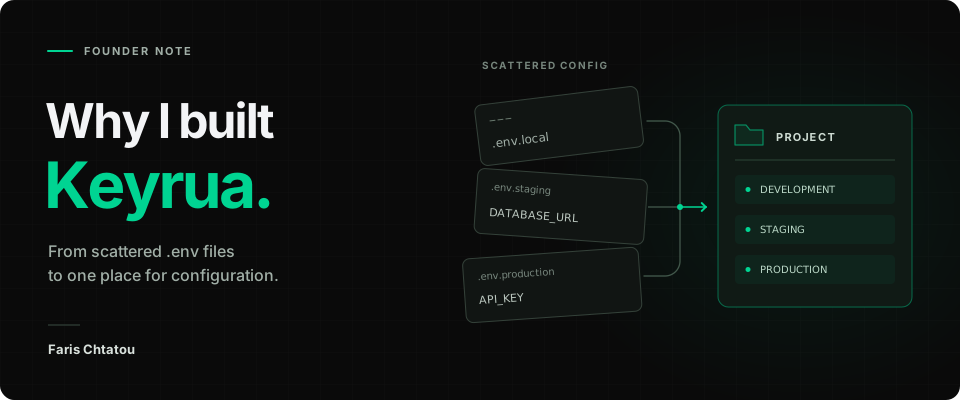
The idea for Keyrua came from my previous company, a small software development company. We shared our environment variables in Slack.
Finding them again was a pain. The variables had already been shared, but getting back to the right configuration for each environment meant searching through messages. Having the information somewhere did not make it easy to use when we needed it.
That is the frustration behind Keyrua. I wanted a shared place where a development team could organize configuration by project and environment, then come back to it without having to reconstruct a conversation.
If you run a software development agency, you may recognize the problem immediately. Your team is ready to work on an application. The next step is supposed to be building something for the client. Instead, someone needs to find the right variables before that work can begin.
The file is somewhere. The context is harder to find.
Consider a developer picking up a task on a client application. They open the repository and start setting it up. The application needs a database connection, an API key, and a few other variables before it will run properly.
Someone has those values. They may even have been posted in a channel the developer can access. Finding a message with a .env attachment looks like progress, but there is still context to establish: which environment it belongs to, whether the values are current, and whether that is the configuration this developer should be using.
Those are reasonable things to check. The frustrating part is having to piece the answers together every time the configuration is needed.
A value copied from an old message can look perfectly plausible. A filename can tell you that something is a development configuration without telling you whether it is still the one the team uses. The conversation around a shared file becomes part of understanding the file itself.
At my previous company, the part that bothered me was finding the right variables again for each environment. I wanted that lookup to have a clear destination. Choose the project, choose the environment, and retrieve the configuration.
Client work makes the missing context more noticeable
An agency developer can move between very different applications. A client portal, an internal dashboard, and a commerce project each bring their own repositories, dependencies, external services, and environments.
The developer already has application context to recover when switching projects. They need to understand the task, the relevant code, and the behavior they are changing. Configuration becomes another thing to reconstruct if its location and meaning are not clear.
Picture returning to a project after working on another engagement. The team may have updated a service connection while you were away. A teammate may have a newer file than the one on your laptop. Before you investigate a failing request, you need to establish whether you are running with the configuration the rest of the team expects.
That uncertainty is what I wanted Keyrua to reduce. The problem is bigger than finding a string. You need confidence that the string belongs to the project and environment in front of you.
For a company maintaining several of its own applications, the same concern applies. Clear configuration gives people a shared starting point when they return to an application they have not touched recently.
One person's setup can become another person's interruption
When configuration lives in conversations, the person who knows where it was shared can become part of someone else's setup process.
A developer asks for the variables. A teammate pauses what they are doing, finds the relevant information, and passes it on. The request may be quick to answer, but both people have now had to spend attention on it. If the person with the context is unavailable, the original developer still needs a way forward.
I do not think that is a useful dependency to build into routine work. People should be able to help each other with the application itself while having a clear, documented route to its configuration.
The distinction matters when someone joins an existing client project. They already have plenty to learn. Finding out who holds the correct environment variables adds another layer of dependency before they can contribute.
An onboarding document is more useful when it points to a place the team maintains. Instructions to obtain configuration from a named person still depend on that person's availability and knowledge. I wanted the team to have somewhere it could return to, even as the people working on a project changed.
The cost is easy to overlook in a project plan
Configuration retrieval rarely gets its own line in a delivery plan. It sits inside broader tasks such as setting up a project, investigating a bug, or preparing a change for testing.
For an agency lead, that can make the friction hard to see. A task looks ready: the repository is available, the developer has the brief, and the change is understood. Yet the developer is still establishing which values they need before they can work on it.
It is harder to investigate a failing request when you are unsure whether your application is using the expected service connection. You can spend attention on the code while still needing to confirm the configuration behind its behavior. Asking a teammate may resolve that uncertainty, but it brings another person into the task.
The client sees the feature or the fix when it is delivered. They do not see the search through messages that came before it. Inside the agency, that search still competes for the same attention the team needs to understand requirements, build the change, and test it.
That is why this ordinary frustration mattered to me. I wanted retrieving configuration to be a dependable part of getting started, so the team could put its attention into the application.
A small team's budget is a real constraint
We knew about solutions such as Infisical and Doppler. For our small company, the options we were considering did not fit what we could afford at the time.
That was part of the reason I wanted to build Keyrua. The need for a better workflow was already there, even though our budget limited the options we could adopt.
For a smaller agency, a tool needs to fit both the work and the business. The team has to understand how it will use it, what introducing it involves, and whether the cost makes sense across the projects it maintains.
I wanted Keyrua to be something a team could evaluate on a single project. Start with a manageable scope, see whether developers can use it comfortably, and decide whether to bring more of the workflow into it.
Affordability matters to that decision. So does being able to understand the product without making a large organizational change before seeing its value.
What I wanted the experience to feel like
I wanted a developer to know where to go when they needed configuration. The project and environment should give the values their context, and the team should have a shared place to manage them.
That is how Keyrua is organized today. Each project has its own environment variable sets. An agency can organize client applications as projects, while a software company can do the same for the applications it maintains.
Developers can import and export .env files through the web app or retrieve configuration with the CLI. The CLI also supports starting a command with the selected variables through keyrua run. Applications can keep reading environment variables while the team has a defined place to manage the shared configuration.
Project assignments let you give team members access to the projects they work on. Organization administrators retain access across the organization, and project assignments cover every environment within a project. The security and access model explains those boundaries in more detail.
The shared place also makes the refresh step explicit. When a value changes, developers retrieve fresh configuration. Existing exported files and running processes do not update automatically. A team still needs to agree on how it communicates and rolls out those changes.
Those details matter because I want the workflow to be understandable. People should know where values come from, how they get access, and what to do when the configuration changes.
Why I am building this for agencies and software companies
My experience at my previous company gave me a concrete problem to work on. We had shared the variables, and finding the right ones again was still painful. Keyrua grew out of wanting to make that part of the work easier.
For agencies, the appeal is a workflow that can be repeated across client projects. For software companies, it is a shared approach across the applications their teams maintain. In both cases, developers need a clear route to the configuration for the work in front of them.
If the situations in this article sound familiar, start with one project and dummy configuration. Invite a teammate, give them project access, and see whether they can find the intended environment and get the application running from your instructions.
Keyrua is free to start with one project. That gives your team a place to evaluate the workflow before deciding how it should fit across the rest of your work.