
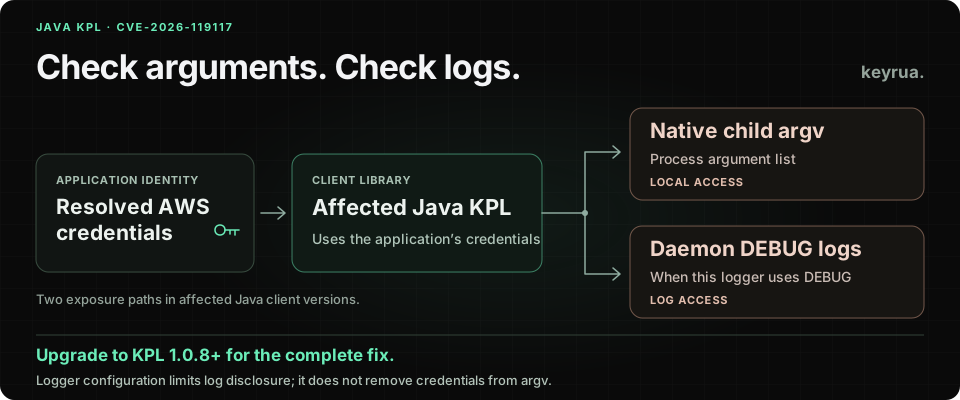
A client application retrieves its AWS credentials through an approved provider. A dependency starts a native child process and puts those resolved credentials in its command-line arguments. A startup diagnostic can then copy them into logs.
That is the credential path described in the new AWS bulletin for CVE-2026-119117, affecting the Amazon Kinesis Producer Library for Java, or KPL. The useful review starts with what the consuming library does after it receives a value.
For an agency maintaining Java producers across client accounts, the work includes identifying deployed versions, checking a specific logger, and establishing where startup diagnostics were retained. Changing the secret’s original storage location does not repair these paths inside an affected dependency.
This guide uses primary sources reviewed on October 31, 2026. The review records and validation plan below are recommendations. No client incident or live exploit test is claimed.
A fresh disclosure with an existing fixed release
AWS dates its bulletin October 30, 2026, at 23:00 PDT, equivalent to October 31 at 06:00 UTC. The linked maintainer advisory identifies the affected packages and rates the issue Moderate, with a CVSS score of 6.5 and a local attack vector.
The notices describe access through local accounts and readable logs. They do not establish active exploitation or a breach of the managed Kinesis service. KPL runs within the customer’s application; using Kinesis alone does not establish that an application uses this library.
AWS identifies KPL 1.0.8 or later as the remediation. The v1.0.8 release was published on September 3, before this disclosure. Describe it as an available fixed version rather than a patch newly released with the bulletin.
Identify the package actually deployed
Check both Maven coordinates from the maintainer advisory:
| Dependency coordinate | Affected versions | Remediation direction |
|---|---|---|
com.amazonaws:amazon-kinesis-producer | <= 0.15.12 | Migrate from the legacy coordinate to the newer package at 1.0.8 or later |
software.amazon.kinesis:amazon-kinesis-producer | < 1.0.8 | Upgrade to 1.0.8 or later |
Use the resolved dependency graph, deployed artifact or image inventory to establish what is running. A changed declaration in the repository does not identify the version inside a worker that has not been rebuilt or restarted.
Record an owner for each producer. For example:
Client: client-demo-a
Consumer: events-producer-demo
Deployed artifact: immutable artifact reference
Resolved KPL coordinate and version: pending verification
Credential sources: stream provider; metrics provider if separately configured
Daemon logger policy: pending verification
Diagnostic destinations: application logs; collector; support bundles
Owner: application team
Validation status: pending
This is a synthetic inventory template. Keep credential references and identity metadata in the record; store actual values through the approved credential workflow.
For an agency, this inventory also helps find producers outside the primary web deployment: scheduled exporters, ingestion workers or older client integrations may have their own release cycle. Treat each running consumer as a separate verification target.
Understand the two exposure paths
The maintainer’s fixes show why changing one setting is incomplete. PR #701 changes credential delivery to the native process from command-line arguments to inter-process communication. It also exposes a separately configurable metrics credential provider in the code being changed. Include that provider in the review when your application uses it.
In an affected version, credentials can therefore reach a process-argument surface after the application has resolved them. The original source might be a role-based provider or configured credentials; the review cannot stop at searching for literal AWS_* variables in deployment settings.
The logging path is separate. PR #699 changes the Java Daemon’s startup DEBUG diagnostic. That diagnostic previously included the native command’s encoded credential material. Hex encoding preserves recoverable values and can make ordinary text-pattern detection less useful.
Process-argument exposure does not depend on DEBUG logging. Log exposure adds another audience: people and systems able to read the emitted diagnostics, potentially beyond the users who could inspect a process on its host.
The practical consequence is a consumer-and-destination review. Identify which identities the library received, then establish which local and logging surfaces were accessible during the relevant deployment period. Avoid assuming that a clean repository or encrypted configuration store answers those runtime questions.
Check the Java Daemon logger specifically
As an interim measure, AWS says to set the relevant Java logger explicitly to INFO or higher in the application’s logging configuration:
KPL 1.x: software.amazon.kinesis.producer.Daemon
KPL 0.x: com.amazonaws.services.kinesis.producer.Daemon
Use the name appropriate to the deployed package. An explicit override matters when a parent or root logger enables DEBUG. KPL’s own LogLevel setting controls a different setting and does not configure this Java logger. See the bulletin’s workaround details.
AWS also recommends filtering the startup message beginning Starting Native Process in the log pipeline. Review how a filter interacts with your actual logging format and collector; a configured rule needs validation at the destination.
These measures reduce future logging exposure. Affected versions still pass credentials in process arguments, so upgrading remains necessary. Previously retained records also need a separate review.
Follow diagnostics beyond the application log
A startup message can travel further than the application team’s first log view. Map the destinations that your deployment actually uses:
| Destination | Review question |
|---|---|
| Process supervision and host diagnostics | Who could access process information on the affected host or container? |
| Application stdout or files | Was the relevant Daemon diagnostic enabled during the exposure window? |
| Central log collectors and indexes | Which accounts, groups and integrations could retrieve retained records? |
| Exported diagnostics and support bundles | Were affected records copied into another system with different access or retention? |
This table describes a review method, not evidence that every destination received credentials. Establish what was emitted and forwarded before deciding the scope of remediation.
Prefer configuration, version, time-window and access evidence in the working report. Review potentially affected records within the authorized logging system. Pasting a complete startup command or log match into a ticket can create another retained copy of the value you are investigating.
For necessary incident evidence, follow the client’s preservation process and restrict access. Coordinate redaction or removal of affected copies with that process. An application upgrade will not edit an existing collector index or an exported support bundle.
Treat credential containment as its own operation
Use the identities and time window from the consumer inventory to decide which credentials need containment with the AWS account owner. Distinguish long-lived IAM user keys from temporary credentials and role sessions.
AWS’s IAM session-revocation procedure applies a deny policy to older sessions of the selected role. It can affect legitimate consumers sharing that role, while newly issued sessions after the cutoff remain allowed. The procedure has role-specific limitations; review them with the owner before applying it to a client account.
Replacing an originating IAM user key also does not invalidate temporary credentials already issued, as AWS explains in its access-key exposure guidance. Inventory the credential types rather than assuming that one replacement invalidates every related session.
Patching a library, restarting a process, replacing a key and denying older sessions address different parts of the response. If an affected consumer continues to run, it can disclose replacement credentials through the same vulnerable path. Plan containment and consumer remediation together, with the urgency of the actual exposure guiding their order.
Our credential-rotation guide covers the broader issuer and consumer handoff. This KPL review adds the dependency and diagnostic destinations that the handoff needs to account for.
Validate with metadata and inert test configuration
Before closing the application work, verify the rebuilt artifact and every running producer instance. An evaluation plan can include:
- Dependency evidence: confirm the resolved package in the deployed artifact meets the fixed-version requirement.
- Logging configuration: confirm the correct Java logger’s effective level, including when the application’s root logger changes.
- Controlled startup: exercise the updated producer in an isolated test setup using inert configuration and restricted diagnostic access. Record behavior without publishing command lines or credential values.
- Consumer operation: check the intended producer and any separate metrics path using the client’s approved validation process.
- Retained destinations: record the review decision for each relevant log index or exported diagnostic copy.
These are proposed checks, not results from a reproduced vulnerability. A successful producer request demonstrates an operation; it does not independently prove that every diagnostic destination is clean.
Keep evidence for the deployed version, the owner’s containment decision and remaining follow-up work. That gives the next engineer a concrete record of what was verified for this client.
Where Keyrua helps, and where the dependency must be fixed
An agency still needs a maintained place for project configuration: the stream identifier, region and any values the team is authorized to share. For workloads that support AWS role credentials, use the provider’s workload-identity path rather than turning temporary credentials into a shared configuration file for convenience.
Keyrua organizes team configuration by project and environment and supplies values to authorized API or CLI consumers. Its CLI fetches configuration before launching a process; that process receives the real values. See the documentation and security model.
That startup handoff does not control what a dependency subsequently writes into child arguments or logs. Keyrua does not patch KPL, revoke AWS credentials or erase diagnostic copies. Project assignments also cover all environments in the project, and organization administrators inherit project access.
Use the advisory to review one deployed consumer from credential resolution through its diagnostic destinations. The useful completion record identifies the running fixed version, the affected identities and the destinations your team has actually checked.